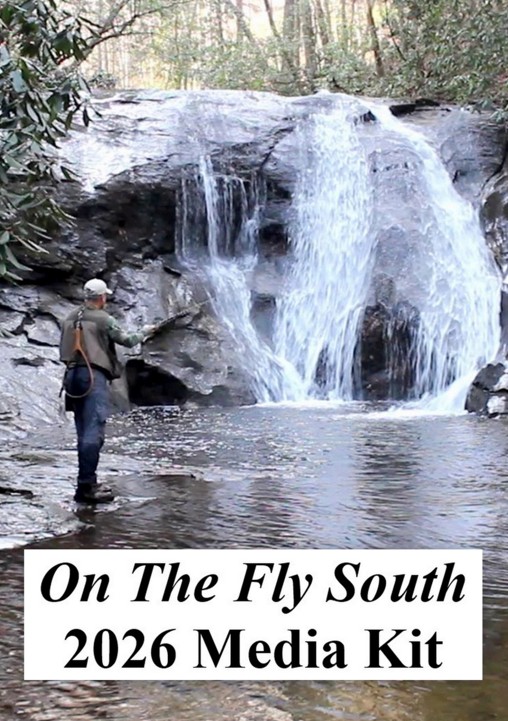
This long North Georgia waterway has many facets, including some good trout fishing!
On The Fly Freshwater
_______________________________________________________________________________________________________________________________
Sponsored By

_______________________________________________________________________________________________________________________________
September 2025
Article and Photos by Jimmy Jacobs.
Georgia’s Etowah River has many faces as it cuts a long swath through the northern portion of the state. The stream joins the Oostanaula River in the City of Rome in the western portion of the Peach State to form the Coosa River. That area features the first of the river’s many faces with regard to fly fishing.
The lower end holds wild, stream-bred striped bass that join white bass on spawning runs up the river from Alabama’s Weiss Lake. That is one of just a handful of land-locked breeding populations of stripers in the nation.
Farther upstream the river passes through Allatoona Lake near the northwest suburbs of Atlanta. In that body of water and the river above it, Alabama bass are the staple of the angling, along with striped and hybrid bass. Traveling east upstream, the river is then home to a good population of Coosa redeye bass.
Then, near the gold rush town of Dahlonega, the Etowah curves north to its headwater just south of Forest Service Road 42 and the Appalachian Trail in northwest Lumpkin County. This upper end of the river offers cold, freestone waters that are home to rainbow and brown trout. It is this part of the river that holds some good options for fly casting in a remote and scenic area.

A stocker from the main stem of the Etowah.
At one time this upper Etowah, along with several feeder streams, were in the lower Blue Ridge Wildlife Management Area overseen by the Georgia Wildlife Resources Division, but on U.S. Forest Service land in the Chattahoochee National Forest. Due to budget constraints, a couple of decades back, the WRD dissolved that half of the WMA, while continuing to manage the northern section near the town of Blue Ridge. Fortunately, that had no effect on the angling, with the Forest Service maintaining the land and fishery for the public.
Over the years, however, the upper Etowah has seemed at times to be “mobile.” That is to say, that back in the mid-1900s it was often call the Hightower River. Then later, some maps showed the river starting at the junction of Jones and Montgomery Creeks.
More recent maps show the portion that was Montgomery Creek as the main stem of the Etowah all the way up to the spring where it originates. A feeder stream formerly known as the West Fork of Montgomery, now is labeled as Montgomery Creek. At any rate, once you figure our which waters are which, there is some good fishing options available.
In this mountainous habitat, all of the streams rate as small to medium-sized, offering a mixture of stocked and wild trout. The bulk of these will be rainbows, but the drainage also has some browns. That is especially true of the afore mentioned Jones Creek.

Some old instream structure on the Etowah.
The best access to upper Etowah can be found where Hightower Church Road crosses the river. That point is just north of the road’s intersection with FS 28-1. At the north end of that bridge, a dirt drive runs to the west along the river. Through here there are several primitive campsites, including one at the end of the short road.
In this area the stream has several calmer pools separated by mild riffles. This area of the Etowah is stock with trout. Fish are released here weekly from April to July 4, then twice per month through Labor Day. The campsites along here often are full on weekends.
At end of the drive past the camping area there also is space to park. From that point you can wade across the creek to reach fishermen’s trails leading upstream. A few of the stockers will move up into this area, but you begin to encounter mostly wild trout as you go upstream. At roughly a quarter mile there’s a stair step shoal and above that it is all wild trout.

The stair-step shoal at the edge of wild trout water.
A few hundred yards farther up, Montgomery Creek enters from the left side. Though it looks quite small at its mouth, it has a couple of big waterfalls with large plunge pools. Overall this creek has more holding water than you would expect. It is a good wild trout fishery if you like bushwhacking.

Lower Black Falls on the Etowah River.
Continuing up the main stem of the Etowah, you quickly encounter Lower Back Falls. This cascade used to be called Black Creek Falls, which was one more reason for confusion regarding names of the creeks. The plunge pool below the falls marks the upstream end of fishing on the Etowah. That’s because just above it lies the U.S. Army’s Frank D. Merrill Ranger Training Camp, complete with shooting ranges. In fact, don’t be too surprised if your fishing is interrupted by low-flying helicopters headed to or from that base. It’s not a place you want to walk out into unexpectedly.

As you might expect, in the lower stocked water the trout run in the 8- to 11-inch range. The wild ones upstream are more likely 6 to 8 inches long. However, Montgomery Creek often holds some in the 9- to 10-inch range.
Be aware that fishing these waters in the August to September period in particular often presents lower water levels. In the crystal-clear flow this high up, the fish get very wary, so you have to be stealthy to slip up on them.