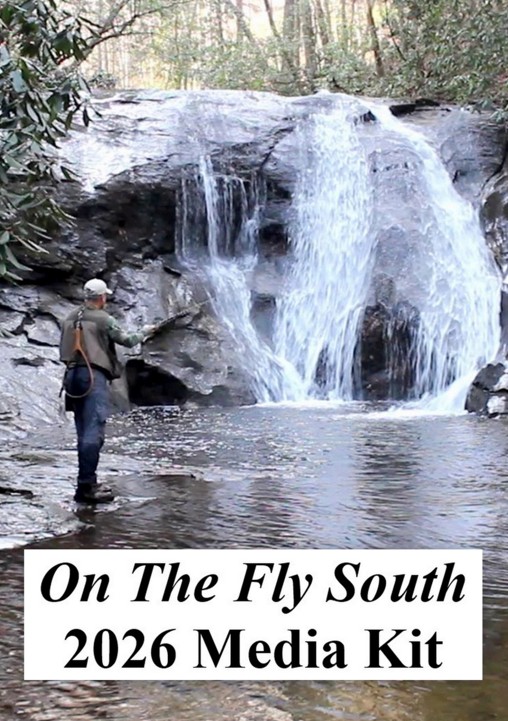
The birthplace of delayed-harvest fishing in North Carolina
On The Fly Freshwater
_______________________________________________________________________________________________________________________________
Sponsored By

_______________________________________________________________________________________________________________________________
October 2025
Article and photos by Jimmy Jacobs
The delayed-harvest section of North Carolina’s Nantahala River is much like a once famous movie star that has passed her prime. That diva of the silver screen was once the talk of the town and adored by a horde of admirers. Now, however, though she may retain her talent, the crowd’s attention has moved on to younger starlets.
The Nantahala was in fact the first stream in the North Carolina to be managed with delayed-harvest regulations. That began back in 1993, when the Old North States fisheries managers began those special regulations. For a time, the river had the limelight to itself, unchallenged by other waters.

Today, North Carolina has expanded the delayed-harvest program to include a total of 30 streams and rivers. Against that back drop, the Nantahala’s reputation has faded a bit. In fact, when measured against the Tuckasegee River that is in the same drainage, it is not hard to see why that happened.
For the 2025 DH season, the Nantahala stocking plan calls for 1,320 rainbow trout and a similar number of brookies to be released each month in October and November, as well as in March to June. Additionally, 660 brown trout are to be stocked in each of those months. That’s a total of 19,800 trout in the 4 miles of DH water. Meanwhile, the 12.9 miles of the Tuckasegee’s two DH areas will get a total of 53,800 trout released. Obviously, that disparity draws attention away from the Nantahala.

Catching a “slam” of all three trout species is not rare on the Nantahala DH section.
The regulations for delayed-harvest angling are the same on all of North Carolina’s waters. From March 1 to the first Saturday in June, only single hook, artificial lures may be used and all trout must be immediately released. During the rest of the year regular hatchery-supported stream regulations apply.
So, does all this point to the Nantahala fishing going downhill? That would be a definite no. In fact, Trout Unlimited has included the Nantahala in it list of the Top 100 Trout Streams in America. Let’s have a closer look at this section of the Nantahala and its fishery.

The stocked trout encountered in the DH region on the Nantahala generally run from 9 to 11 inches long. However, there is some carry over of trout, especially in the case of browns. Fish up to 20 inches show up every year. On a good day, it’s not unusual to catch and release double-digit numbers of trout on the river.
The name Nantahala comes from the Cherokee language and identified the river valley as the “Land of the Noon Day Sun.” If you have ever driven along the flow downstream of Nantahala Lake through the DH section and gorge below, you readily understand that moniker. The towering mountains on both sides shade the valley except when the sun is directly overhead.
The DH waters on the Nantahala begin at the mouth of Whiteoak Creek. If you look up that stream from the bridge over it, you can see an impressive waterfall. From that creek mouth, the DH section runs downstream on the Nantahala for 4 miles. The entire section is paralleled by paved Wayah Road (SR 1310). Along the way there are numerous pull offs for parking to fish.

Access to the Nantahala is ease, since the river is right at roadside.
The lower end of the DH section ends where water is released from the powerhouse associated with the Nantahala Lake dam. Water is diverted through a pipe from the dam to this site, so water releases have no effect on the delayed-harvest section.
A lot of the Nantahala is easily waded, interspersed with some deeper holes. Usually, those pools have some areas from which you can cast from the bank.
Well-known casting instructor and fishing guide Mac Brown of Bryson City has described the Nantahala as an excellent “bug factory.” That’s because the river harbors healthy populations of Black Stoneflies, Black Caddis, Red Quills, Hendricksons, Quill Gordons, Blue Quills and March Browns. As you might expect from that list of insects, the river can host some exceptional dry fly action when hatches are occurring. But personally, I’ve found success on this water tossing attractor patterns like the Royal Wulff and Parachute Adams as well.
Especially during the fall and winter months of the delayed-harvest season, dreary overcast days are common. With that type condition, some huge Blue Winged Olive hatches take place. In those instances, the trout have a laser focus on that particular bug. That’s the time to tie on a BWO emerger pattern in size No. 18 or 20, but a BWO dry fly version in No. 18 also is a good option.
Anytime there is no surface action taking place, employing a dry-dropper rig multiplies your chances of attracting a strike. Pheasant Tails, Gold-Ribbed Hare’s Ears or Prince Nymphs in sizes No. 12 to 14 or smaller are good choices for the dropper fly.
Additionally, tossing black or olive Wooly Buggers in the deeper runs works. That also is likely to attract some of the bigger, hold over rainbows and browns.