Hendersonville, North Carolina
On The Fly Freshwater
_______________________________________________________________________________________________________________________________
Sponsored By

_______________________________________________________________________________________________________________________________
April 2025
Article and photos by Jimmy Jacobs
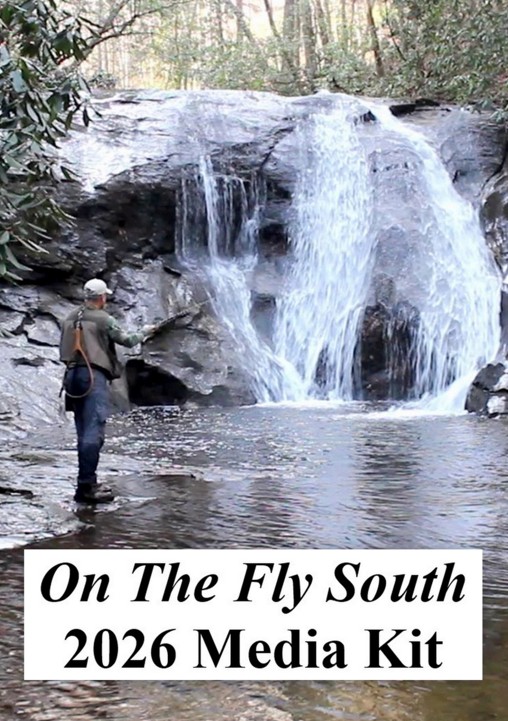
North Carolina’s South Mills River is one of the backcountry jewels of trout fishing in the eastern portion of the nation. Throughout its course it teems with wily and wild rainbow and brown trout, as it offers miles of angling territory that can only be reached on foot.
Before anyone gets their dander up about “hot-spotting” a wild fishery, it is worth noting that Trout Unlimited has listed the South Mills as one of its 100 best trout streams in the U.S. for decades. This river is no secret, having been publicized for years. Additionally, it is not easily accessed and offers 12 miles of remote water that provides plenty of room for angling.
The South Mills River rises near the Blue Ridge Parkway in North Carolina’s northern Transylvania County. From there it flows east under US 276 near the Cradle of Forestry in America historic site. This site is where scientific forestry was first practiced in this country, when George Vanderbilt of the Biltmore Estate hired Gifford Pinchot to manage surrounding woodlands in 1892. Eventually, it was also the location of the first forestry school in the United States.
Where the river is crossing the historic site property, it features a number of beaver ponds. These small bodies of water contain numbers of small, wild brown trout. Once past US 276 the river turns south at an old gauging station in the shadows of Funneltop Mountain, the South Mills tumbles over High Falls. Turning west it then crosses into Henderson County and flows off the Pisgah Game Lands of the Pisgah National Forest at a point between Buttermilk Mountain to the north and Forge Mountain on the south. Eventually, the South Mills joins the North Mills to form the main stream of the Mills River.
_______________________________________________________________________________________________________________________________
Sponsored By

_______________________________________________________________________________________________________________________________
At the old water gauge, which stands is a tall stone structure at stream side, the South Mills is a medium-sized stream. Downstream of this point, the river traverses a roadless area. The South Mills River West Trailhead (FT 133) is located here, with that path continuing for 12 miles down river to the Turkeypen Trailhead on FS 297, just off US 280. The trail travels mostly along old roads, with a portion on the bed of an abandoned logging railroad. It also follows the river shore, but does drift away around the High Falls area.

Through here the river is a series of deep, clear pools broken by short stretches of riffles. Although there are several smaller waterfalls, the entire valley is surprisingly level. Be aware, however, that there is a concrete and a swing bridge crossing the river on the trail, along with nine spots where the trail fords the stream.

This lower portion of the South Fork is noted for giving up some big trout, up to the 20-inch range. Most are likely to be browns, but they can be quite difficult to fool. Their favored hangouts are in the deeper pools where the clear water is flowing slower. Too much movement and these crafty old fish will see you before you can even deliver a cast.
Some hefty rainbows do show up, as well. Despite that promise, expect the average fish to be in the 8- to 11-inch range. The rainbows tend to be easier to catch because of their proclivity for being in moving water where surface turbulence provides you with the opportunity to get to them with less likelihood of spooking the fish.

Like most Southern Appalachian freestone streams, the South Mills hosts a variety of aquatic insect life that forms the forage base for the trout. And similarly to other waters, this river does not get a lot of hatches of individual bugs. What hatches occur tend to be sporadic and quite unpredictable. The exception is during the hot summer months when caddis flies in sizes 12 to 16 can show up in numbers.
The best, and only practical, access points to the South Mills for anglers are found at each end of the South Mills River Trail. For the western, upriver access, from the Pisgah District Ranger Station and Visitor Center on US 276, go north for roughly 10 miles. Turn right on FS 1206 (Yellow Gap Road). After another 3 ¼ miles, make a right turn onto FS 476 (Wolf Ford Road). The trailhead is at the end of this road in the Wolf Ford Horse Camp.
For the alternate east end of the South Mills River Trail, turn south on US 276 from the aforementioned ranger station and visitor center parking lot. At 1 ½ miles turn left on NC 280.
Go east on NC 280 for another 5.2 miles and take a left on Turkeypen Road (FS 297). This is immediately after crossing the Transylvania/Henderson County border. Drive 1.2 miles to the Turkeypen Gap Trailhead Parking Area at the end of the road. The trail starts near a kiosk and road gate at the far end of the parking area.