Lumpkin County, Georgia
On The Fly Freshwater
Sponsored By

___________________________________________________________________________________________
January 2024
Article and photos by Jimmy Jacobs
When serious trout fishermen in the Peach State start talking shop, you very rarely hear them mention any of the more popular, regularly stocked streams in the northern mountains. No doubt there are several reasons for that situation.
Those waters are very popular and thus always crowded on weekends and even some weekdays. That doesn’t make for a very satisfying day on the water. Additionally, many of the anglers that do show up are bait fishermen. They tend to stake out a pool, sit down and stay there for long periods. Common courtesy calls for skipping around them, which leaves much of the creek off limits.
Finally, many anglers will point to preferring to look for wild fish, or at least ones that have been in the creek for a while, rather than the trout freshly stocked from the hatchery.

On the other side of this coin, it is worth noting that a number of Georgis’s creeks in the mountainous northern third of the state that are stocked, would be natural trout water even without the release of fish. Most of those are “grandfathered” into the stocking program from earlier days when the state was trying to rebuild the ravaged trout fishery of the region.
Once a creek was stocked and built up a following of anglers, it makes it tough to suddenly change horses in mid-stream, so to speak.
All of which is a good description of the situation on Dicks Creek in Lumpkin County and just north of the old gold rush town of Dahlonega, It has been stocked weekly during the spring through fall for many years, yet it also contains wild trout.
Dicks Creek rises in the federally-mandated Blood Mountain Wilderness Area and begins its journey south just below Horsebone Gap on the Appalachian Trail. Along the way it picks up the waters of Lance, Blood Mountain and Miller creeks, before reaching Dicks Creek Falls and the mouth of Waters Creek near that cascade. The stream then exits the state’s Chestatee Wildllife Management Area, to flow into the Chestatee River. From the mouth os Lance Creek, down to the edge of the WMA, Dicks Creek Road parallels the stream closely.

Particularly in its lower reaches on public land, Dicks has some very large and deep pools. I talso has several marked, primitive campgrounds along its shores. As one might expect, where camping is provide and water is deep, these spots also attract swimmers in warmer months.
The farther up one fishes on Dicks Creek, the more wild trout are encountered. The bulk of these are going to be smaller rainbows in the 4- to 8-inch range, but browns also are present all the way to the headwaters. What sets Dicks apart from other smaller streams is that some very large trout have been taken from its waters over the years. In fact, three straight year jus after the millennium, rainbows that topped 7 pounds were taken annually from the creek’s public area! One brown reported from Blood Mountain Creek topped 19 inches, despite the small size of that feeder.
Obviously, your chances of hooking such a small-stream monster are modest at best on this creek. But apparently, they do show up.

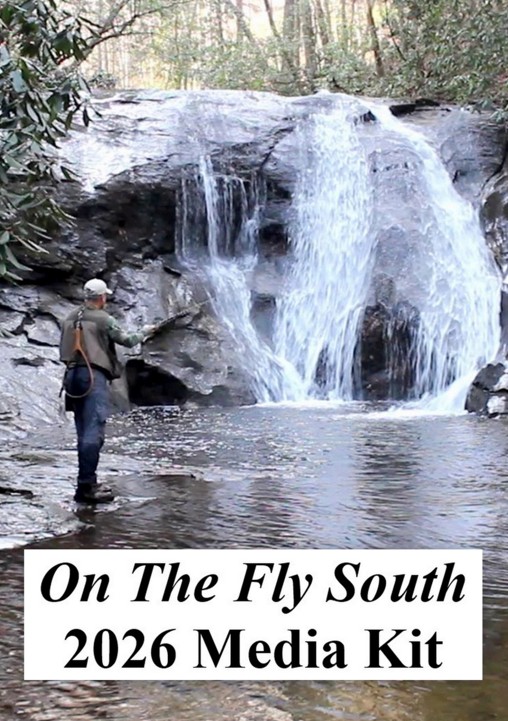
On one fishing trip on Dicks Creek reinforced the opinion that the stream has two distinct faces. For the casual camper/angler just wanting to catch a few fish for dinner, the slow, deeper pools held stocker rainbow and brown, many so fresh from the hatchery that they were missing fins rubbed off on the concrete raceways. Those pools were often at the foot of the many small waterfalls – and some bigger ones – along the flow.
On the other hand, On The Fly South Associate Editor Polly Dean discovered a pattern for finding the creek’s wild brown trout. She ignored those pools and looked for shallower runs that were draped with rhododendron or other shoreline vegetation. All that was needed was 18 inches to 2 feet of water flowing under these and enough clearance to get a dry on the surface. These situations were not the kinds of places the spin and bait anglers usually target. But they wer perfect lairs for the brown trout.

Her approach when it came to flies also was a bit different. Rather than tossing smaller attractor patterns that often work on mountain streams, she went bigger. A No. 10 grasshopper pattern proved to be the ticket, provoking some savage, splashy rises from the browns. Her tactics worked throughout the stream’s course.

As for the rainbow trout, the lower portion of the creek gave up stocked fish in the 8- to 10-inch range, but also had the most anglers. Farther up the stream the rainbows were wild, a bit smaller and far more colorful. In both cases the rainbows were in pools, but the wild fish often were in smaller potholes within the shoals.
Dicks Creek proved that even the most popular stocked streams can provide angling suited to any taste. Visiting it or similar waters on a week day improves the aesthetics, and with a bit of experimentation, you can find a pattern that will scratch your angling itch.