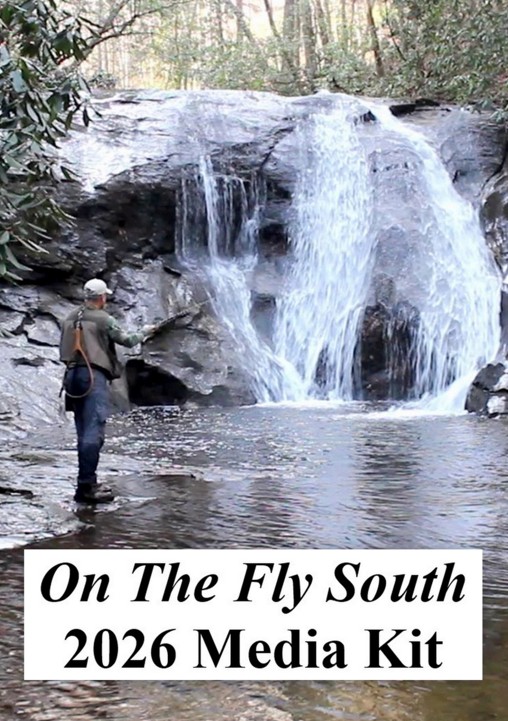
Jacks River, Georgia
On The Fly Freshwater
_______________________________________________________________________________________________________________________________
Sponsored By

_______________________________________________________________________________________________________________________________
March 2025
By Paul Diprima
Photos by Jimmy Jacobs
Almost everyone has watched some type of survival show such as “Running Wild with Bear Grylls” or other shows where someone is left in a remote location with little in the way survival gear. Just prior to the establishment of the Cohutta Wilderness I took a weeklong adventure to the Jacks River with little more than a frying pan, tent, knife, jar of honey, fire starter, fly rod, several gallons of water and a pellet pistol. On my way into the Jacks River, I took the side road that paralleled the river. The Chevelle proved that it was not meant to be an off-road vehicle. A wheel dropped into a rut and a sharp stone penetrated the gas tank. The hole in the tank was not large, but it could drain the tank in a day or two and ruin my adventure.
I had to make a choice: Stop the leak or go home. I decided to stop the leak. I found a hickory limb about the diameter of a pencil and cut a tapered point on one end and squared the other end. I crawled under the car, cut the pointed end to a shape resembling the hole and gently tapped the wooden plug until it was snug and the leak stopped. As long as I did not do anything to dislodge the plug, it was safe to resume my adventure.
It never rained and I fished a lot. In the Cohutta Mountains the water is gin clear and fish are easily spooked. One technique I used was sitting perfectly still on the creekbank for several minutes letting the dry fly float a couple of rod lengths away in a pool or a run. A little tug on the line with my left hand would cause the fly to move just enough to get a trout’s attention. This is not the traditional way to use a fly rod but after many previous trips I knew that it was an efficient way to catch trout. In an eat or starve situation, catching is important.

I caught trout, shot a few bullfrogs and foraged for edible wild plants. I was also lucky and found a large patch of strawberries growing on the side of a trail. After a few days, the gas tank was beginning to drip a little and my stomach yearned for more than frog legs and trout, so I headed home to get the gas leak resolved.
I was thinking about fly fishing and the Cohuttas yesterday and asked myself, what fly rod and fly would work best if you were just dropped off in some remote location. This unknown spot might have lakes, rivers, the smallest creeks or even the ocean.

Here are a few of my thoughts on survival with a flyrod. First of all, no flyrod is perfect for all waters. A 2-weight brook trout rod may never land a full-grown striped bass and a 12wt tarpon rod is not appropriate for brookies or even the largest bass. What is the compromise? A 5-, 6- or 7- rod could work, but which is best?
On wide rivers and open streams, long rods work well. Lakes and the ocean usually dictate long rods. The smaller streams in the East and Southeast are usually overgrown and they are where I commonly use my 6-foot, 6-inch rod. Let’s compromise with the 6-weight rod, 8 feet long, with a large capacity reel.
What about flies? All flies will wear out after catching fish. Only having one will not be wise. Classic trout flies are not good for all fish or water types. In a survival mode, not knowing where you will be fishing dictates what I call flies for all occasions. In warm weather I have caught bream, bass, trout, catfish and saltwater fish on cork-bodied poppers. They look like insects that have landed on the water. You should have duplicates of varying colors and sizes. Streamers work well in summer and winter. Wooly buggers, Lefty’s Deceivers, are versatile and large nymphs can imitate shrimp in saltwater. Don’t forget leader material from 30-pound to 6-pound. Maybe some wire leader for toothy saltwater fish.
Yes, the flyrod is a perfect survival tool in almost any area of the world that has water and fish. Don’t worry about technique. Do what is necessary to catch fish. All you want is something to eat.