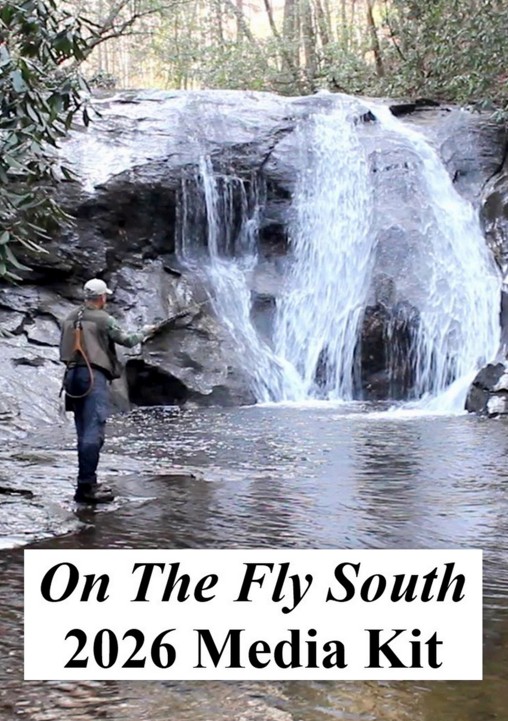
West Prong of the Little River, Tennessee
_________________________________________________________________________
Sponsored By

_________________________________________________________________________
On The Fly Freshwater
November 2026
By Jim Casada
Photos by Jimmy Jacobs
For many years I taught weekend fly-fishing classes in the non-credit program known as the Smoky Mountain Field School operated by the University of Tennessee. The University had partnered with the Great Smoky Mountains National Park for a wide array of class offerings, and this particular class operated out of park headquarters at Sugarlands, just a short way from Gatlinburg. The site was ideal. There was a training room with tables, a screen, and other essentials at the Park Visitor Center. A spacious lawn adjacent to park offices offered an ideal spot for casting practice. Best of all, the West Prong of the Little Pigeon River flowed not more than 100 yards away.
Getting 15 or 20 people in a stream all at once is a non-starter, but the situation was ideal for the instructor to take to the water and offer a sort of visual guide to what fishing park waters was like. I did this, two or three times every summer, for a period of perhaps 15 years. In all that time, probably totaling 35 to 40 in-stream demonstrations, I caught at least one trout on every occasion but one. On that single exception the stream almost out of banks and dingy thanks to days of heavy rain. None of the trout caught during these demonstrations measured more than 10 or 11 inches, and most were considerably smaller. Yet managing to catch a trout right next to one of the busiest spots in the park with onlookers lined up streamside, and do so with regularity, says a great deal about the appeal and promise of the West Prong.

The West Prong is a stream of many faces. Appreciable portions of it, beginning with the lower reaches within the park adjacent to the Visitor Center, are readily available from any of the numerous pull-off spots along U.S. Highway 441 as it climbs ever upward from Gatlinburg towards Newfound Gap. That portion includes appreciable stretches of stream flowing through the lower reaches of a huge geographical bowl or basin with the interesting name of the Sugarlands. There’s some argument as to whether the name derived from an abundance of sugar maple trees or the prevalence of moonshine making, with sugar being an essential ingredient, that flourished here in pre-park days. At the upper end of the Sugarlands the road gradually moves away from closely paralleling the stream. At this point, far below U.S. 441, the West Prong drops through a deep gorge where one plunge pool after another is the norm.
That situation continues for a distance that leaves an angler in the stream feeling as if he was somewhere deep in the heart of the backcountry rather than just a half mile or less from a heavily travelled road. It is only at the Chimneys Picnic Area that U.S. 441 returns to the stream, crosses it, and continues upward towards the spine of the Appalachians. The stretch of water from the point in the Sugarlands where the road leaves close proximity to the creek to the picnic grounds is long enough to make for a very full day of fishing, and once the angler is committed to it, he is in effect pretty well “stuck.” Short of taking on the guise of a mountain goat to climb out to the highway, you just have to keep plugging along, often scrambling over huge boulders to get from one pool to the next.
Fishing this stretch requires some fitness and plenty of time, but the rich rewards are worth all of the effort and then some. You shouldn’t expect to catch large fish — anything above 10 inches is a trophy — but every pool and riffle has the potential of yielding a wild beauty or two. Moreover, this stretch of water sees a gradual but important change in the nature of the fish you catch. Lower down it’s all rainbows, beautifully colored and wild as the waters in which they swim. But as you make your way ever upwards in the gorge, those brightly colored ‘bows increasingly give way to the true inhabitant of mountain waters, speckled trout — you can call them brookies or brook trout, but to a mountain lad like yours truly they are just “specks” or “natives.” To bring one of these jewels to hand or net, with their vermiculated backs of interwoven grey and olive tones blending with brilliant crimson spots encircled by golden halos is to sample a small piece of piscatorial paradise.

A Smoky Mountain “speck.”
By the time the road returns to the stream you will be catching mostly if not exclusively natives, and in the upper reaches of the West Prong, now once more close by the road in the Alum Cave Bluffs trailhead area, you are in the most readily accessible speckled trout water to be found anywhere in the park. It’s skinny water for the most part, nothing like the plunge pools downstream, but thanks to the nature of the topography and extremely thin soil up on the main ridgeline, frequent flooding keeps the stream surprisingly open and conducive to decent elbow room for casting.
The West Prong may not be praised or publicized to the same degree as other park streams on the Tennessee side such as Greenbrier, Little River, or Abrams Creek, but thanks to a perfect blend of ready accessibility and remoteness, nicely paired with mixture of rainbows and natives, it’s mighty appealing. That’s particularly true from its junction with Road Prong in the area beneath the storied Chimneys on downstream.
As for tactics and techniques suitable for the West Prong, like most other medium or smaller sized park streams, decent presentation rather than long casts is the angler’s top priority. Most pools don’t require, and in many cases don’t allow, casts of more than 30 feet. More often than not you can figure on half that distance and holding the rod tip high, with nothing but the fly in the water to avoid drag. As for choices of patterns, when it comes to dry flies something that floats high and is readily visible (Parachute Adams, Adams Variant, deer-hair flies, any of the Wulff patterns, or Hoppers and other terrestrial imitations in summer and early fall) will work well. Better still, fish with a small beadhead dropper (size 16 or 18 hook) such as a Prince pattern a foot and a half below the dry fly. That’s readily manageable with short casts.

When fishing the lower reaches take a bit of time to note signs in the form of stone walls, chimney remains, and the like that remind one of the hardy folks who once called this place home. Indeed, if you are of a reflective nature, take a few minutes to wander through the little cemetery found right in the heart of the Visitor Center complex and perhaps ponder an epitaph on a tombstone there that reads:


That’s a bit eerie, but in a perverse way it also tugs at the angler’s heart and makes him realize he is privileged to be wading and wandering, casting and wondering, in a place that is a wee piece of piscatorial paradise. Or, if he happens to be of a cynical turn of mind, an additional two lines might possibly be added:

I throw that bit of what some might deem frivolity in because, as widely venerated angling sage Arnold Gingrich reminded us in a book of that title, Fishing’s Only Part of It.
Jim Casada is a son of the Smokies and the author of the most detailed book on fishing Park waters. To learn more about him, this book, and many others he has written, visit his web site at www.jimcasadaoutdoors.com.