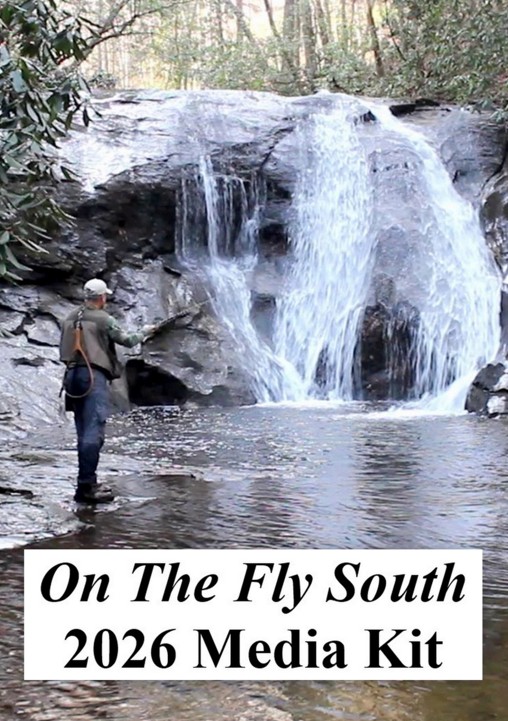
This cast can solve several problems on the water.
The Casting Connection
June 2024
By Capt. Scott Swartz
Scott Swartz founded the Atlanta Fly Fishing School, which began in 1999. It is the largest such operation in the Southeast and the only Trout Unlimited “Gold Endorsed” school in the United States. His Florida Fly Fishing Schools started in 2008, helping anglers
learn to successfully fly fish in saltwater.
The roll cast is good to have in your arsenal of casts. It is most often used when there is limited space to make a regular back cast, but it is also helpful in many other situations.
One efficient use of the roll cast is fishing upstream. After a cast is made upstream the current naturally pushes your fly back toward you. If you raise your rod tip, keeping pace as the current returns your fly, a loop of line will form beside you. The weight of the loop and tension of water will provide resistance to make another cast upstream without the need for repeated false casts to get the line back out.
Another use of the roll cast is to raise a weighted fly or sinking fly line to the surface. When your fly is too deep to easily lift out of the water try a few roll casts to lift the fly closer to the surface before casting.
Roll casting also works well when you have a strong wind at your back making regular casts difficult. Here a roll cast can be helped by the wind as long as you can form a loop of line by your side for tension to make the cast.

As to the technique of roll casting there is good news! It is simply the forward portion of the conventional cast. Only the back cast is modified. Use the grip, stance, and arm position of your basic overhead cast when you roll cast. Starting with the line on the water in front of you, slowly raise the rod tip up (way up), slightly away, and slightly behind you so a loop of fly line forms from your rod tip behind you to the water near your feet. The remainder of the line will be on the water in front of you. Now lower your arm to the position it would be at the end of a normal back cast and execute the roll with a strong forward cast. The forearm is moved toward the target first and the wrist will turn the rod tip over to complete the cast.
The power should be at maximum near the end of the cast just before a crisp stop. Stopping very sharply allows the rod to throw the line. It is important the rod tip tracts a straight path toward the target all the way to the stop to send the line out in front of you. A very common error is to sweep the rod in a big circle with the rod tip coming down toward the water at the end of the cast. This often results in a cast that does not extend out to the target landing short with slack line. Performed correctly the loop you cast will look like an elliptical oval or a short, flattened O.
To perfect roll casting you should practice on water because the surface tension of the water holds your line, helping to load your rod for a cast. This is a perfect technique for small streams where a back cast has our flies in the rhododendron. Now, if we can keep our forward casts out of the bushes, we’ll catch more fish.
Send your casting questions to Scott@AtlantaFlyFishingSchool.com